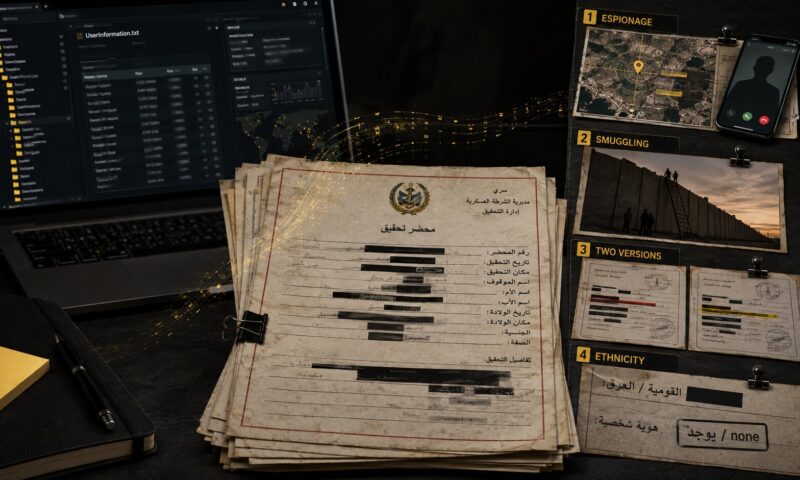

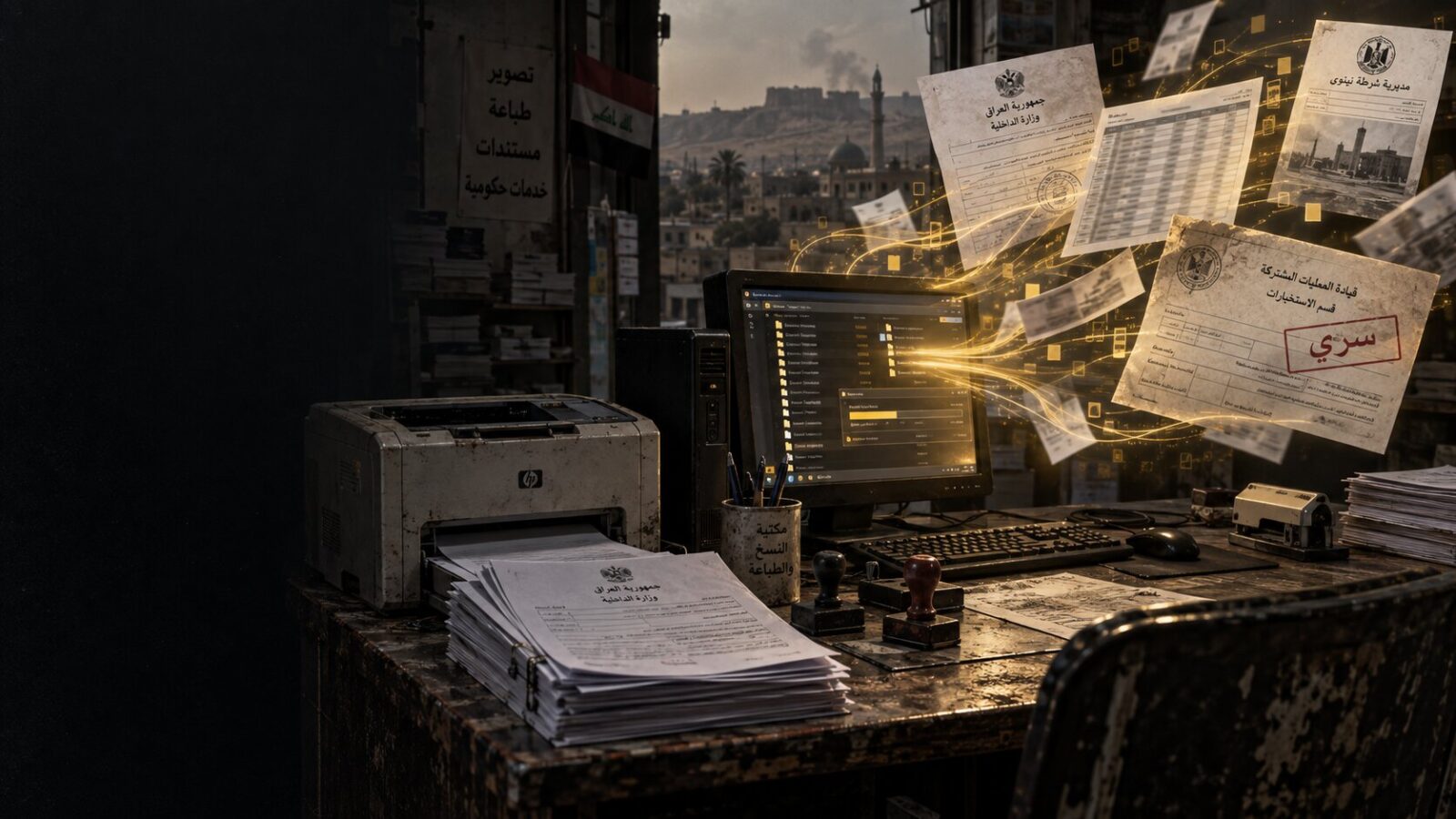

In September 2023, an infostealer infection hit a small print shop in Qayyarah, Iraq – a walk-in vendor that, it turns out, at least four Iraqi police units and an army brigade all paid to type up their paperwork. Neither the police nor the army was breached. But their documents were on that machine, including a 189-name list that labels each person “the ISIS member” beside his village, his job, and whether he still owns his house.
How This Surfaced
The file that started this investigation was a spreadsheet-style Word document, recovered from an infostealer log dated 30 September 2023. Its title, in the compiling institution’s own words, was an inventory of ISIS-linked houses within the responsibility sector of the Imam Gharbi Police Station – and it ran to 189 named individuals across eight villages, one row per person, each labelled in the name column as اسم الداعشي: “the ISIS member’s name.”
A police station’s internal list of alleged ISIS affiliates should be on a police computer. This one was in a folder with more than a hundred other Word files – and the further into that folder we went, the less it looked like anything a police station owned.
Whose Computer Is This?
The first thing that complicated the police-computer theory was that the Imam Gharbi list was not the only official document in the folder – and the rest of them did not belong to the same institution.
Directly exposed – their own internal casework was sitting on the machine:
- Imam Gharbi Police Station – the 189-name ISIS house inventory.
- Al-Hurriya police station – a 2023 detainee register, a different station entirely.
- Qayyarah Police Section, Nineveh Police Directorate – a “basic register” cover sheet dated 2022, and a charge slip booking a named defendant under Article 456 of the Iraqi Penal Code, case year 2023.
- The Ministry of Interior’s Community Policing Division for Nineveh – a blank visitor’s log on its letterhead.
- The Iraqi Army’s 76th Infantry Brigade (Movements Section) – a daily duty roster and two classification-marked message forms.
- The Qayyarah agriculture office – a storm-damage inspection report.
That is at least four separate police entities and an army brigade – bodies that do not share filing systems, buildings, or chains of command. No officer has legitimate custody of all of that. No single unit’s clerk produces all of it. At that point the “government machine” assumption stopped holding together.
A second layer sat beside it: not institutions whose own files were on the machine, but institutions and officials named as recipients inside petitions the same shop typed for ordinary residents:
- The Prime Minister of Iraq’s office, as Commander-in-Chief of the Armed Forces – two separate letters, each from a different retired officer.
- The Qayyarah Investigative Court
- The Popular Mobilization Forces’ administrative and financial affairs department
- The Ministry of Electricity
- The Nineveh Health Directorate
- The Husseini Shrine’s General Secretariat in Karbala
- The Qayyarah national-ID office
Of all the recipients above, the Prime Minister’s office reached furthest. One letter is a retired lieutenant colonel of police’s pension-rank appeal; the other is a retired major general’s request to be recalled to active duty – both typed at the same commercial counter as the ISIS list, both covered in full further below. They belong on this list for what they establish here: this shop’s paperwork did not stay local. It reached the desk of the country’s most senior office, twice.
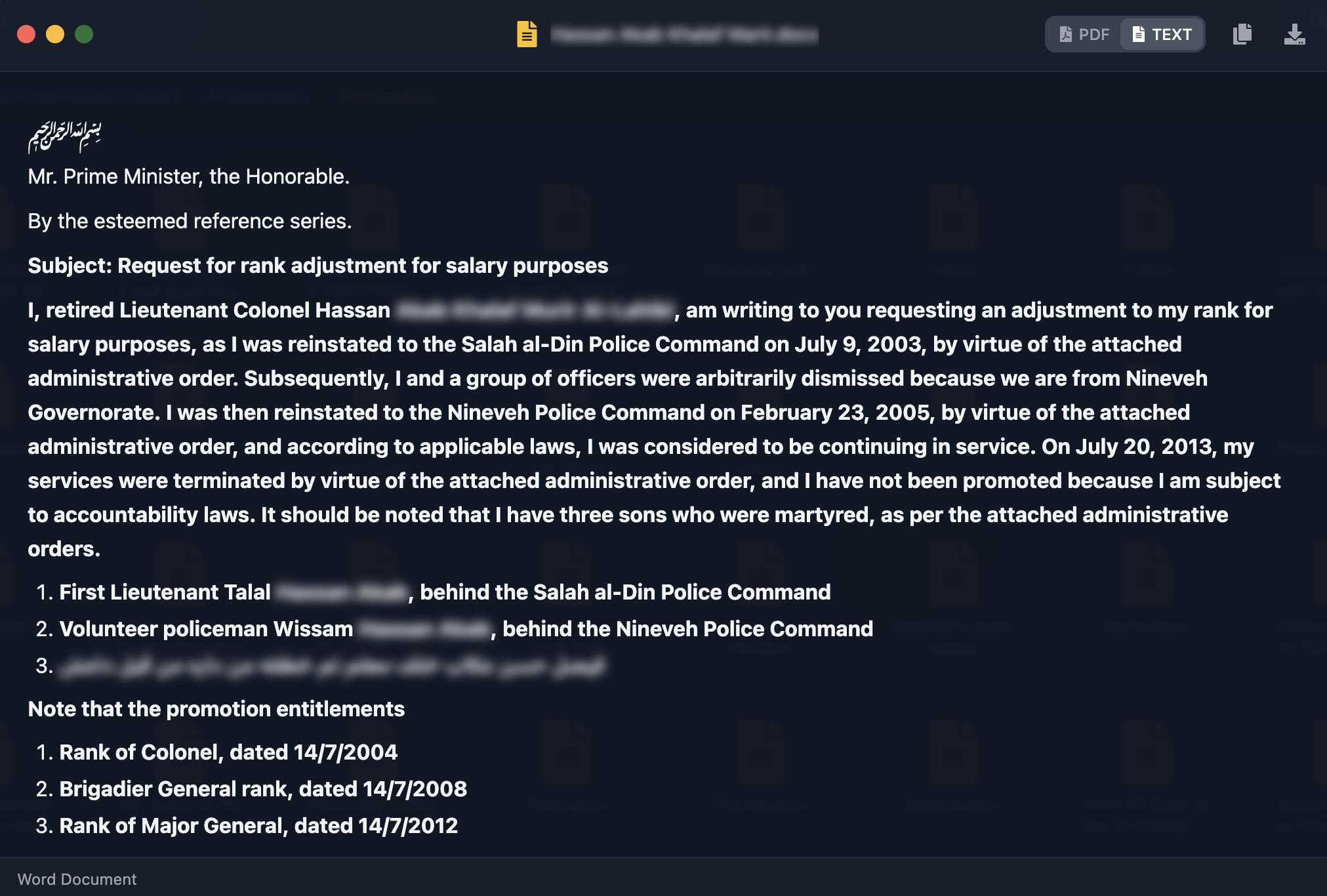
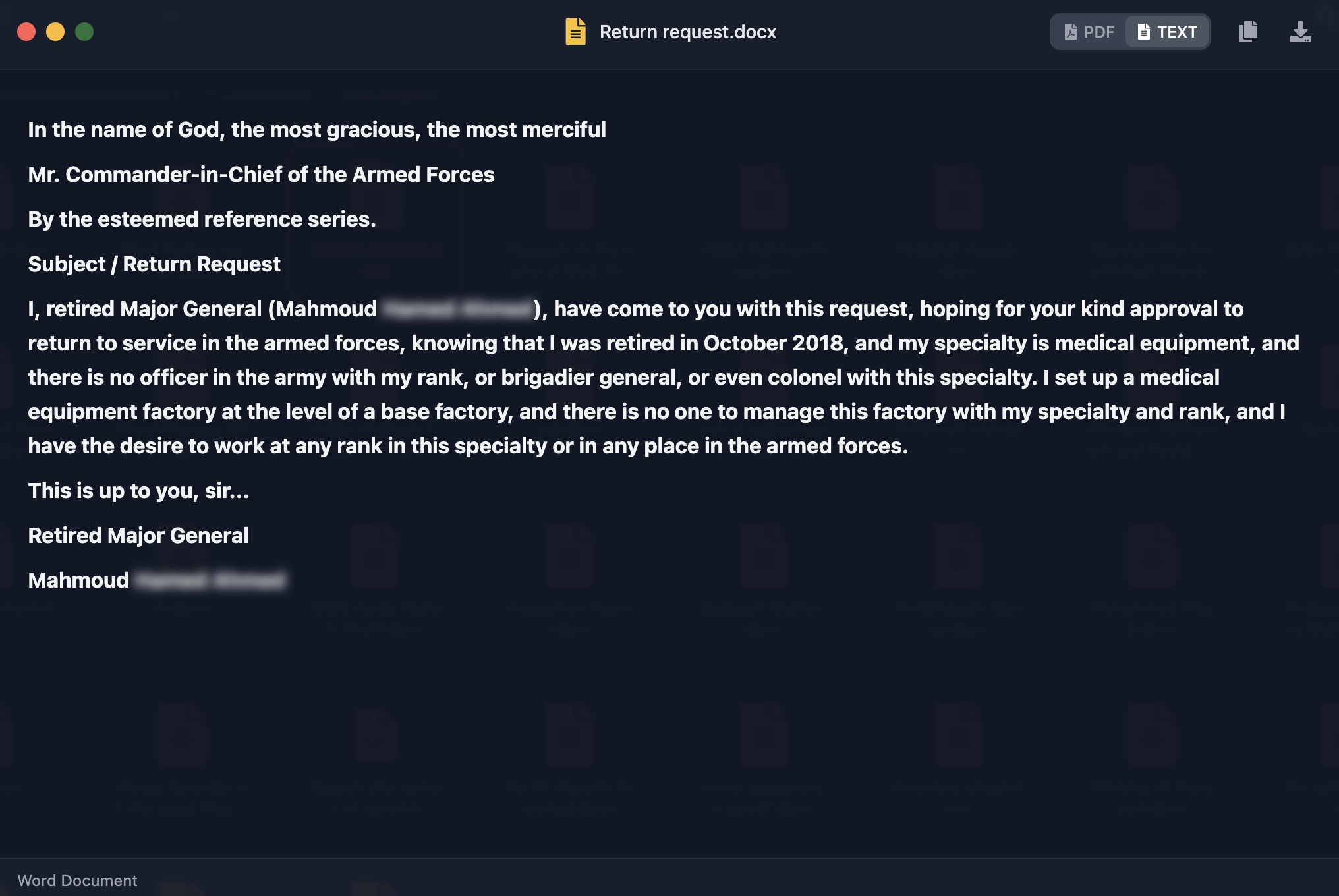
No evidence of a police or military owner
The log gave us nothing in the other direction either. An institutional machine is usually easy to identify from an infostealer log: a domain-joined profile, a work address in the autofill data, saved credentials for a government portal, an organisation name on the Windows account. This machine had none of it.
PC – no institution or individual namedNo department logon, no official email account, no credentials for any state system, no institutional branding anywhere in the profile. If this were an officer’s machine – even a personal one used for work – some trace of the employer would normally show up. There was none. Ownership had to be established the way it would be for any anonymous device: from what the machine was actually used for.
What the machine actually was
Three signals, all pointing the same way
- The software fleet is a print counter’s, not an office desk’s. Driver suites for three competing printer/scanner brands at once – Canon, Epson, and three separate HP Enterprise-class multifunction devices – the full Adobe design suite, three OCR packages, and Kelk, a professional Arabic typesetting program built for exactly one trade: laying out documents for print. No single officer or employee runs that stack for their own work; it is the toolkit of a walk-in print-and-design business.
- The file mix is a public counter’s, not one office’s. Of the 100+ Word files recovered, most have nothing to do with government business at all: a blacksmith’s invoice pad, a water-tanker delivery business, a concrete-block factory, a cigarette kiosk register, a tailor’s ledger, a “500 chickens” coop listing, school worksheets, Friday sermon drafts. The institutional documents sit inside that pile as a minority, not as the whole of it.
- The relationship was recurring, not a single visit. The institutional documents alone span a stamped 2022 register cover sheet through a 2023 charge slip and a 2023 detainee register, alongside the live police inventory list – meaning these institutions came back to the same desk repeatedly, over at least two years, to have sensitive material typed.
This was not a police officer’s personal laptop and it was not a military workstation. It was a civilian small business that several separate government bodies used, over an extended period, as an unofficial back office.
Why a police station uses a print shop at all
To a reader in a well-resourced administration this looks bizarre. It is not. Across under-resourced public administrations – Iraq very much included, with comparable patterns widely observed elsewhere in the Middle East, South Asia, and parts of Africa – independent typing and photocopy shops cluster immediately outside courthouses, police stations, land registries, and passport offices, and they function as the de facto back office for the public and the institution alike. The drivers are structural rather than cultural:
The 189-Name ISIS List
Of everything that came off that desktop, this is the document that matters most – both because of what it contains and because of what its construction reveals about the institution that produced it.
The document is headed, in the police station’s own words:
جرد دور الدواعش ضمن قاطع مسؤولية مركز شرطة امام غربي
“Inventory of ISIS-linked houses within the responsibility sector of Imam Gharbi Police Station.”
Its column headers are a small bureaucratic decision with a large effect. The first data column is not “resident” or “family of a suspect” – it is اسم الداعشي, literally “the ISIS member’s name.” Six more columns follow: the village, the confirming police station, the house owner’s current residence, his job, whether the house is owned or not, and a final “other notes” column that is blank in all 189 rows.
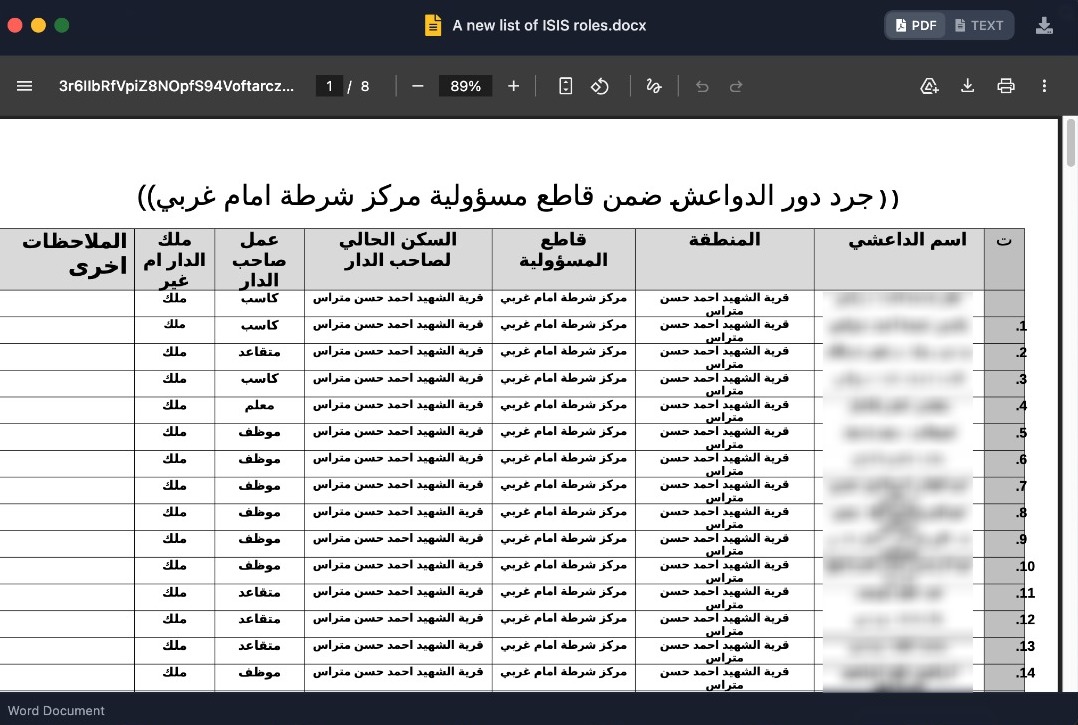
| # | Name | Village | Job | Ownership |
|---|---|---|---|---|
| 1 | علي جمعة **** ***** Ali Jumaa ***** ****** | Martyr Ahmad Hasan Matras village | self-employed | owner |
| 2 | ياسين جمعة **** ***** Yasin Jumaa ***** ****** | Martyr Ahmad Hasan Matras village | self-employed | owner |
| 3 | ساجي رمله ******* ******* Saji Ramla ******* ******** | Martyr Ahmad Hasan Matras village | retiree | owner |
| 4 | احمد جمعة **** ***** Ahmad Jumaa ***** ****** | Martyr Ahmad Hasan Matras village | self-employed | owner |
| 5 | محسن خضر **** Muhsin Khidr ***** | Martyr Ahmad Hasan Matras village | teacher | owner |
| 6 | ******* *** **** ****** ***** ***** | Martyr Ahmad Hasan Matras village | employee | owner |
| 7 | **** *** **** ******** ***** ***** | Martyr Ahmad Hasan Matras village | employee | owner |
| 8 | *** ****** ******* *** ***** *** ******** ****** ***** ****** | Martyr Ahmad Hasan Matras village | employee | owner |
| 9 | **************** *** ***** *** ******* ****** ***** ****** | Martyr Ahmad Hasan Matras village | employee | owner |
| 10 | *** ****** ******* *** ***** *** ********* ****** ***** ****** | Martyr Ahmad Hasan Matras village | employee | owner |
| 11 | *** ****** *** ******* *** *** ********* **** ****** ***** | Martyr Ahmad Hasan Matras village | employee | owner |
| 12 | *** *** **** ** ****** **** | Martyr Ahmad Hasan Matras village | retiree | owner |
| 13 | ******* **** **** ****** **** | Martyr Ahmad Hasan Matras village | retiree | owner |
| 14 | **** *** **** ******** ****** **** | Martyr Ahmad Hasan Matras village | retiree | owner |
| 15 | ******* *** ******* ******* ******* ****** ******* ****** | Martyr Ahmad Hasan Matras village | employee | owner |
| 16 | ****** **** **** **** ******** ***** ******** ***** | Martyr Ahmad Hasan Matras village | employee | owner |
| 17 | **** **** ******* ******* ***** ****** ******* ******** | Martyr Ahmad Hasan Matras village | retiree | owner |
| 18 | *** **** ******* ******* *** ****** ******* ******** | Martyr Ahmad Hasan Matras village | self-employed | owner |
| 19 | *** ******* *** **** ***** ******** *** ***** | Martyr Ahmad Hasan Matras village | retiree | owner |
| 20 | *** **** **** **** ***** ****** ***** ******** | Martyr Ahmad Hasan Matras village | self-employed | owner |
| 21 | **** **** ******* *** **** ***** ***** ******** *** ***** | Martyr Ahmad Hasan Matras village | self-employed | owner |
| 22 | **** **** ******* *** **** ***** ***** ******** *** ***** | Martyr Ahmad Hasan Matras village | self-employed | owner |
| 23 | **** **** ******* *** **** ******** ***** ******** *** ***** | Martyr Ahmad Hasan Matras village | self-employed | owner |
| 24 | **** **** ******* *** **** ***** ***** ******** *** ***** | Martyr Ahmad Hasan Matras village | self-employed | owner |
| 25 | **** ******* *** ******* ******** ******** *** ******** | Martyr Ahmad Hasan Matras village | self-employed | owner |
| 26 | ********* **** ******* *** **** *** ******* ***** ******** *** ***** | Martyr Ahmad Hasan Matras village | self-employed | owner |
| 27 | *** **** ******* *** **** *** ***** ******** *** ***** | Martyr Ahmad Hasan Matras village | self-employed | owner |
| 28 | ******* *** **** **** ******** ***** ******** ***** | Martyr Ahmad Hasan Matras village | self-employed | owner |
| 29 | ***** *** ******* *** ******* ***** ******** *** | Martyr Ahmad Hasan Matras village | self-employed | owner |
| 30 | **** *** ****** *** ******** ***** ******** *** | Martyr Ahmad Hasan Matras village | retiree (f) | owner |
| 31 | **** ********** *** **** ***** ******** *** | Martyr Ahmad Hasan Matras village | security affiliate | owner |
| 32 | **** *** ******* *** ****** ***** ******** *** | Martyr Ahmad Hasan Matras village | self-employed | owner |
| 33 | **** *** ***** ******* ***** ***** | Martyr Ahmad Hasan Matras village | military | owner |
| 34 | ***** ********** *** ***** ***** ******** *** | Martyr Ahmad Hasan Matras village | self-employed | owner |
| 35 | **** *** ******* *** ***** ***** ******** *** | Martyr Ahmad Hasan Matras village | self-employed | owner |
| 36 | *** *** **** ***** ***** *** ****** ******* | Imam Gharbi village | self-employed | owner |
| 37 | *** *** **** ***** **** *** ****** ******* | Imam Gharbi village | self-employed | owner |
| 38 | *** *** **** ***** **** *** ****** ******* | Imam Gharbi village | self-employed | owner |
| 39 | **** ******* *** ******* ******* **** | Imam Gharbi village | self-employed | owner |
| 40 | **** *** *** **** ***** **** **** ****** | Imam Gharbi village | self-employed | owner |
| 41 | ******* *** *** **** ******** **** **** ****** | Imam Gharbi village | self-employed | owner |
| 42 | **** ***** **** *** ***** ****** ******** ***** | Imam Gharbi village | self-employed | owner |
| 43 | ***** **** *** ******* ***** ***** ***** ******** | Imam Gharbi village | self-employed | owner |
| 44 | **** ***** *** **** ******** ******* ****** ****** | Imam Gharbi village | self-employed | owner |
| 45 | **** **** ******* **** ***** ***** ******* ****** | Imam Gharbi village | self-employed | owner |
| 46 | **** ***** *** **** ******* ******* ****** ****** | Imam Gharbi village | self-employed | owner |
| 47 | **** ***** **** ***** ******* ****** ***** ***** | Imam Gharbi village | self-employed | owner |
| 48 | ***** **** *** ***** ***** ****** *** ****** | Imam Gharbi village | self-employed | owner |
| 49 | ******** ******* *** ***** *** ******** ******* *** ****** | Imam Gharbi village | self-employed | owner |
| 50 | **** *** **** ***** ***** ****** ***** ******* | Imam Gharbi village | self-employed | owner |
| 51 | **** **** *** ***** **** ***** ****** ******* | Imam Gharbi village | self-employed | owner |
| 52 | **** **** **** *** ******** **** ****** *** | Imam Gharbi village | self-employed | owner |
| 53 | **** **** **** *** ***** **** ****** *** | Imam Gharbi village | self-employed | owner |
| 54 | **** **** *** **** ******** ***** ****** ****** | Imam Gharbi village | self-employed | owner |
| 55 | **** **** **** **** ****** ***** **** ****** | Imam Gharbi village | self-employed | owner |
| 56 | **** *** **** *** ***** ****** ****** *** | Imam Gharbi village | self-employed | owner |
| 57 | ***** *** **** ********** *** **** ***** ***** ***** ****** ***** * ***** ***** ****** ***** ****** ** ******* | Imam Gharbi village | self-employed | owner |
| 58 | *** ******* **** ***** ***** ******* ******** ***** | Imam Gharbi village | self-employed | owner |
| 59 | **** ******* **** ***** ***** ******* ******** ***** | Imam Gharbi village | self-employed | owner |
| 60 | *** ******* **** ***** **** ******* ******** ***** | Imam Gharbi village | self-employed | owner |
| 61 | **** ******* **** ***** ***** ******* ******** ***** | Imam Gharbi village | self-employed | owner |
| 62 | **** ******* **** ***** ****** ******* ******** ***** | Imam Gharbi village | self-employed | owner |
| 63 | **** ******* **** ***** ******* ******* ******** ***** | Imam Gharbi village | self-employed | owner |
| 64 | **** **** **** **** ******** ***** ******** ****** | Imam Gharbi village | self-employed | owner |
| 65 | *** **** ********* **** ***** ******** *** ********* **** | Imam Gharbi village | self-employed | owner |
| 66 | *** *** *** ******* **** **** ***** ******** | Imam Gharbi village | self-employed | owner |
| 67 | **** *** **** *** ****** *** ****** *** | Imam Gharbi village | self-employed | owner |
| 68 | **** *** **** *** ***** *** ****** *** | Imam Gharbi village | self-employed | owner |
| 69 | **** **** ***** *** ******** ***** ****** ****** | Imam Gharbi village | self-employed | owner |
| 70 | *** **** ***** *** ***** ***** ****** ****** | Imam Gharbi village | self-employed | owner |
| 71 | ***** *** **** *** ****** ***** ******** ****** | Imam Gharbi village | self-employed | owner |
| 72 | *** **** *** **** **** ***** *** **** | Imam Gharbi village | self-employed | owner |
| 73 | **** *** *** ***** **** ****** *** ******* | Imam Gharbi village | self-employed | owner |
| 74 | **** *** *** ***** ***** ****** *** ******* | Imam Gharbi village | self-employed | owner |
| 75 | **** ***** ******* **** ***** ****** ******** ***** | Imam Gharbi village | self-employed | owner |
| 76 | *** **** ******* **** *** **** ******** ***** | Imam Gharbi village | self-employed | owner |
| 77 | **** **** **** ******* ****** **** ******* ******** | Imam Gharbi village | self-employed | owner |
| 78 | **** ********* **** **** ******** *** ******** ***** ******** | Imam Gharbi village | self-employed | owner |
| 79 | **** **** **** **** ****** ****** ******** ******* | Imam Gharbi village | self-employed | owner |
| 80 | *** *** **** ***** ***** ***** ***** ****** | Imam Gharbi village | self-employed | owner |
| 81 | ***** *** *** **** ***** ***** ***** ***** | Imam Gharbi village | self-employed | owner |
| 82 | ********* *** *** **** *** ******* ***** ***** ***** | Imam Gharbi village | self-employed | owner |
| 83 | ********* *** *** **** *** ******** ***** ***** ***** | Imam Gharbi village | self-employed | owner |
| 84 | ********* *** *** **** *** ******** ***** ***** ***** | Imam Gharbi village | self-employed | owner |
| 85 | ** *** **** ***** **** ***** ***** ****** | Imam Gharbi village | self-employed | owner |
| 86 | **** **** *** ***** ***** ******** *** ****** | Imam Gharbi village | self-employed | owner |
| 87 | **** *** **** **** ***** ***** ***** ******* | Imam Gharbi village | self-employed | owner |
| 88 | **** **** **** **** ******** ****** ******** ******* | Imam Gharbi village | self-employed | owner |
| 89 | **** *** *** **** ******** *** ***** ***** | Imam Gharbi village | self-employed | owner |
| 90 | ***** **** **** **** ***** ****** ***** ******* | Imam Gharbi village | self-employed | owner |
| 91 | **** **** **** **** ***** ******** *** **** | Imam Gharbi village | self-employed | owner |
| 92 | ******* **** **** **** ******* ***** ****** ***** | Imam Gharbi village | self-employed | owner |
| 93 | **** ******* **** **** ****** ******* ****** ***** | Imam Gharbi village | self-employed | owner |
| 94 | ********* **** **** *** ******* ***** ***** | Imam Gharbi village | self-employed | owner |
| 95 | ******* ***** ********* *** ***** ******* ********* | Imam Gharbi village | self-employed | owner |
| 96 | *** *** **** ***** ***** *** ******** ******* | Imam Gharbi village | self-employed | owner |
| 97 | **** **** ********* **** ***** ******** *** ********* **** | Imam Gharbi village | self-employed | owner |
| 98 | **** *** **** ***** *** ***** | Imam Gharbi village | self-employed | owner |
| 99 | **** **** **** **** ******** ******** ******* ******* | Akridi al-Jaziz village | self-employed | owner |
| 100 | **** **** **** ***** ***** ******** ******* ******** | Akridi al-Jazira village | self-employed | owner |
| 101 | **** ***** **** **** ******* ***** ***** **** ***** ********** | Al-Murayr village | security affiliate | owner |
| 102 | **** ***** **** **** ***** ***** **** ***** | Al-Murayr village | self-employed | — |
| 103 | **** *** **** **** ******* ***** ****** ***** ***** ********** | Al-Murayr village | retiree | owner |
| 104 | **** *** **** **** ******* ****** ****** ***** ***** ********** | Al-Murayr village | self-employed | owner |
| 105 | **** *** *** **** ******* **** ***** ****** ***** ********** | Al-Murayr village | self-employed | owner |
| 106 | **** *** *** **** ******* ***** ****** ***** ***** ********* | Al-Tina village | self-employed | owner |
| 107 | **** *** *** **** ******* ****** ****** ***** ***** ********* | Al-Tina village | self-employed | owner |
| 108 | **** ***** **** ****** ******* ****** | Al-Tina village | self-employed | owner |
| 109 | **** *** *** **** ******* ******** *** **** ******** ********* | Ajmasa al-Jazira village | security affiliate | owner |
| 110 | **** *** ***** *** ******* ******** **** ****** ****** ********* | Ajmasa al-Jazira village | self-employed | owner |
| 111 | **** *** ***** *** ******* ***** **** ****** ****** ********* | Ajmasa al-Jazira village | self-employed | owner |
| 112 | **** **** *** **** ******* ****** ***** ****** ****** ********* | Ajmasa al-Jazira village | self-employed | owner |
| 113 | ***** ***** *** **** ******* ******* ****** ****** ****** ********* | Ajmasa al-Jazira village | self-employed | owner |
| 114 | **** **** ***** *** ******* ***** ******* ****** ****** ********* | Ajmasa al-Jazira village | self-employed | owner |
| 115 | **** **** ***** *** ******* ***** ******* ****** ****** ********* | Ajmasa al-Jazira village | self-employed | owner |
| 116 | **** **** ***** *** ******* **** ******* ****** ****** ********* | Ajmasa al-Jazira village | self-employed | owner |
| 117 | **** **** ***** *** ******* ***** ******* ****** ****** ********* | Ajmasa al-Jazira village | self-employed | owner |
| 118 | ******* ****** **** **** ******* ******** ******** ***** ****** ********* | Ajmasa al-Jazira village | self-employed | owner |
| 119 | **** ******* ****** **** ******* ******** ******** ******** ***** ********* | Ajmasa al-Jazira village | self-employed | owner |
| 120 | **** *** *** **** ******* ****** ****** *** ***** ********* | Ajmasa al-Jazira village | self-employed | owner |
| 121 | ***** *** *** **** ******* ****** ****** *** ***** ********* | Ajmasa al-Jazira village | self-employed | owner |
| 122 | **** **** **** *** ******* ***** ****** ***** ****** ********* | Ajmasa al-Jazira village | self-employed | owner |
| 123 | **** *** ******* *** ******* ***** *** ******** *** ********* | Ajmasa al-Jazira village | self-employed | owner |
| 124 | ******* **** *** **** ******* ******** ***** ****** ****** ********* | Ajmasa al-Jazira village | self-employed | owner |
| 125 | **** ******* **** *** ******* ***** ******** ***** ****** ********* | Ajmasa al-Jazira village | self-employed | owner |
| 126 | **** *** ******* *** **** ***** *** ******** *** ***** | Ajmasa al-Jazira village | self-employed | owner |
| 127 | **** **** **** *** ******* ***** ****** ***** ****** ********* | Ajmasa al-Jazira village | self-employed | owner |
| 128 | **** **** **** **** ******* ***** ***** ***** ******** ********* | Ajmasa al-Jazira village | self-employed | owner |
| 129 | **** *** *** **** ******* ******** *** **** ******** ********* | Ajmasa al-Jazira village | self-employed | owner |
| 130 | **** *** ***** *** ******* ******** **** ****** ****** ********* | Ajmasa al-Jazira village | self-employed | owner |
| 131 | ******* *** *** **** **** ******* ***** *** ***** ******* | Jarnaf Gharbi village | self-employed | owner |
| 132 | ******* **** **** **** ******* ******* ****** ***** ****** ********* | Jarnaf Gharbi village | self-employed | owner |
| 133 | ******* ***** *** ***** ******* ****** ****** ******* | Jarnaf Gharbi village | self-employed | owner |
| 134 | ******* **** **** **** ******* ***** ***** ****** | Jarnaf Gharbi village | self-employed | owner |
| 135 | ******* **** **** ******* ******* ****** ******** ********* | Jarnaf Gharbi village | self-employed | owner |
| 136 | ******* *** *** ***** ******* *** ****** ******* | Jarnaf Gharbi village | self-employed | owner |
| 137 | **** **** **** **** ***** ****** ***** ***** | Jarnaf Gharbi village | self-employed | owner |
| 138 | **** **** **** ******* ******* ***** ****** ***** ******** ********* | Jarnaf Gharbi village | self-employed | owner |
| 139 | **** **** **** **** ******* ***** **** ***** ****** ********* | Jarnaf Gharbi village | self-employed | owner |
| 140 | **** ***** **** **** ***** ******* ***** ****** | Jarnaf Gharbi village | self-employed | owner |
| 141 | **** ***** **** *** ******* ***** ******* ****** *** ********* | Jarnaf Gharbi village | self-employed | owner |
| 142 | **** ***** *** ***** ***** ****** ****** ******* | Jarnaf Gharbi village | self-employed | owner |
| 143 | ******* *** *** ***** ****** *** ****** ******* | Jarnaf Gharbi village | self-employed | owner |
| 144 | **** *** *** **** **** ****** **** ***** | Jarnaf Gharbi village | self-employed | owner |
| 145 | **** ***** **** *** ******* ****** ******* ****** *** ********* | Jarnaf Gharbi village | self-employed | owner |
| 146 | **** ***** **** **** ****** ****** **** ****** | Jarnaf Gharbi village | self-employed | owner |
| 147 | **** **** **** **** ******* **** ******** ***** ****** ********* | Jarnaf Gharbi village | self-employed | owner |
| 148 | **** ******* **** ******* ***** ****** ***** ******** | Jarnaf Gharbi village | self-employed | owner |
| 149 | **** *** *** ***** ***** *** ****** ******* | Jarnaf Gharbi village | self-employed | owner |
| 150 | **** *** **** **** ****** ***** ****** ***** | Jarnaf Gharbi village | self-employed | owner |
| 151 | *** **** **** ***** ***** ***** ***** ******* | Jarnaf Gharbi village | self-employed | owner |
| 152 | *** **** **** **** ***** ****** ***** ****** | Jarnaf Gharbi village | self-employed | owner |
| 153 | *** *** **** **** ******* ***** *** ***** ******* ********* | Jarnaf Gharbi village | self-employed | owner |
| 154 | **** **** ***** ***** ****** ***** ****** ******* | Jarnaf Gharbi village | self-employed | owner |
| 155 | **** **** **** ***** ****** ***** ***** ******* | Jarnaf Gharbi village | self-employed | owner |
| 156 | **** **** *** ***** ****** ***** ****** ******* | Jarnaf Gharbi village | self-employed | owner |
| 157 | **** **** *** **** ****** ******** *** ***** | Jarnaf Gharbi village | self-employed | owner |
| 158 | **** ******* **** ****** ******* ****** | Jarnaf Gharbi village | self-employed | owner |
| 159 | *** **** *** *** ***** ***** ***** *** ****** ******* | Jarnaf Gharbi village | self-employed | owner |
| 160 | *** **** ***** ***** ****** ***** ****** ******* | Jarnaf Gharbi village | self-employed | owner |
| 161 | *** **** **** ***** ****** ****** **** ******* | Jarnaf Gharbi village | self-employed | owner |
| 162 | *** ***** *** ***** ****** ****** ****** ******* | Jarnaf Gharbi village | self-employed | owner |
| 163 | *** **** *** *** ****** ******** *** ****** | Jarnaf Gharbi village | self-employed | owner |
| 164 | *** **** **** **** **** ****** ***** ****** ***** ****** | Jarnaf Gharbi village | self-employed | owner |
| 165 | **** ******* **** **** ******* ****** ******** ***** ***** ********* | Jarnaf Gharbi village | self-employed | owner |
| 166 | **** **** **** **** **** ****** ***** ****** | Jarnaf Gharbi village | self-employed | owner |
| 167 | **** *** ***** ***** **** *** ***** ******* | Jarnaf Gharbi village | self-employed | owner |
| 168 | ***** **** ***** ***** ****** ***** ****** ******* | Jarnaf Gharbi village | self-employed | owner |
| 169 | **** **** ***** ***** **** ***** ****** ******* | Jarnaf Gharbi village | self-employed | owner |
| 170 | **** **** **** **** **** ****** **** ****** | Jarnaf Gharbi village | self-employed | owner |
| 171 | **** *** *** ***** **** *** ****** ******* | Jarnaf Gharbi village | teacher | owner |
| 172 | ***** ***** **** **** **** ****** ***** ****** ***** ****** | Jarnaf Gharbi village | self-employed | owner |
| 173 | ***** *** ***** ***** ****** *** ****** ******* | Jarnaf Gharbi village | self-employed | owner |
| 174 | **** **** ******* **** ******* ***** ***** ******** ******** ********* | Jarnaf Gharbi village | self-employed | owner |
| 175 | **** **** ******* **** ***** ***** ******** ******* | Jarnaf Gharbi village | self-employed | owner |
| 176 | **** **** **** **** ***** ** ***** ***** ***** ****** ********* | Jarnaf Gharbi village | self-employed | owner |
| 177 | **** *** *** ***** ***** *** ****** ******* | Jarnaf Gharbi village | self-employed | owner |
| 178 | *** ***** *** **** ***** *** ****** ****** ******** ******* | Jarnaf Gharbi village | self-employed | owner |
| 179 | *** ******* **** **** ******* ***** ******* ****** ******** ********* | Jarnaf Gharbi village | self-employed | owner |
| 180 | *** **** **** **** ******* *** ***** ***** ***** ********* | Jarnaf Gharbi village | self-employed | owner |
| 181 | *** ******* **** **** *** ******** ****** **** | Jarnaf Gharbi village | self-employed | owner |
| 182 | *** *** *** ***** *** *** ****** ******* | Jarnaf Gharbi village | self-employed | owner |
| 183 | *** **** *** **** ******* *** ***** *** ****** ********* | Jarnaf Gharbi village | self-employed | owner |
| 184 | **** **** ***** ***** **** ***** ****** ******* | Jarnaf Gharbi village | self-employed | owner |
| 185 | *** **** ******* **** ******* *** ***** ****** ***** ******** | Jarnaf Gharbi village | self-employed | owner |
| 186 | *** ***** *** ***** *** ****** ****** ******* | Jarnaf Gharbi village | self-employed | owner |
| 187 | *** ***** **** *** ******* *** ******* ****** *** ********* | Jarnaf Gharbi village | self-employed | owner |
| 188 | *** **** **** **** *** ****** **** ****** | Jarnaf Gharbi village | self-employed | owner |
| 189 | *** **** ***** *** ***** *** ****** ****** ****** ******* | Jarnaf Gharbi village | self-employed | owner |
Reading down all 189 rows changes the picture the title suggests. This is not a list of militants. 167 of the 189 people – 88% – are recorded simply as كاسب, a day-labourer or self-employed worker. Eight are government employees, seven are retirees, two are teachers. And at least four are currently serving in the security forces or army themselves – three logged as منتسب (“security affiliate”) and one as عسكري (“military”) – meaning four of the men this document calls “the ISIS member” are, as of the date the list was typed, on the government’s own payroll in uniform.
Every row but one records the house as ملك – owned, not rented – and every current address given is the same village the person is listed against. Nobody on this list has fled. The document is not tracking fugitives; it is tracking occupied homes, which is what makes the “ownership” column meaningful in the first place: this is the kind of field a list keeps when the next administrative step concerns the house itself, not the person’s whereabouts. Lists built on exactly this premise – a household flagged by a single relative’s alleged affiliation, regardless of the rest of the family’s record – are the same mechanism documented for years by rights groups working in post-ISIS Iraq, where they have been tied to blocked returns, demolished homes, and collective punishment of people never charged with anything.
Nothing in the document explains who is on it or why. There is no distinction between a convicted ISIS member, a relative by blood, a relative by marriage, or a namesake. There is only a name, a village, and a house.
A Third-Party Breach, Not a Police Breach
This is the finding worth sitting with longer than the list itself: neither the Imam Gharbi Police Station nor the 76th Infantry Brigade was hacked. Whatever networks they have were never touched. The infection landed on a commercial computer they had no security relationship with – no contract, no endpoint monitoring, no awareness that it was a risk to them at all. It most likely arrived the ordinary way, through pirated software, a bad ad or a disguised download, while the owner was doing nothing more alarming than running a small business.
That was enough to expose the institutional side of the folder. Beyond the ISIS list, it held a 2023 charge slip from Qayyarah Police, a 2022 register cover sheet from the Nineveh Police Directorate, a visitor’s log on Community Policing Division letterhead, and – recoverable by title only – a 2023 detainee register for Al-Hurriya police station and a daily duty roster for the 76th Infantry Brigade headquarters. Spanning at least two years, this is the paper trail of a standing arrangement, not a one-off favour.
درجة السرية: سرية · من: ل مش 76 الحركات · الى: الفوج الأول حركات
A blank Iraqi Ministry of Defence message form, printed by the ministry’s own press, pre-addressed from the 76th Infantry Brigade’s Movements Section to its First Regiment, with a printed classification field reading “secret” and a priority field reading “immediate.”
The two army message forms recovered are blank, but still informative: they confirm a specific brigade and regiment pairing, its routing, and its classification practice – reproduced on a commercial machine that, an hour later, might just as easily have been printing a chicken-coop invoice.
Any organisation that hands sensitive material to a party outside its own security perimeter – a print shop, a subcontractor, a translation service, a courier, a partner unit’s admin clerk – inherits that party’s endpoint hygiene as its own attack surface, whether or not it knows the party exists. A police station’s network can be fully patched and monitored and still leak its most sensitive list, because the leak never had to go through the network at all. The practical question is not “is our network secure,” but “who outside our network is holding a copy of something we would not want to lose – and do we have any visibility into their machine at all?”
The Rest of the Folder
Beyond the two letters to the Prime Minister’s office, the folder holds a wider mix of personal correspondence – pension disputes, reassignment requests, hardship appeals – alongside citizens’ petitions typed for a fee: a power-plant cleaner asking an MP for a job, a widower asking a Karbala shrine for charity, a father correcting his family’s civil-registry entries, a complaint to the investigative court. None of these people are accused of anything, but together they are a counterintelligence problem in miniature: verified registry numbers, named officials, financial and medical details, all assembled and sold without anyone knowing what they had collected.
The rest is small-business paperwork – a blacksmith’s invoice pad, a cigarette kiosk register, a tailor’s ledger, a “500 chickens” coop listing, Friday sermon drafts. None of it is sensitive on its own, but it is the strongest argument against the material being fabricated or staged: nobody assembling a forgery includes a chicken-coop inventory.
Why This Matters, and Who It Matters To
Counter-terrorism and intelligence organisations spend enormous effort trying to see inside the security apparatus of partner states and post-conflict zones – how local forces categorise people, what lists exist, what happens to a household once it appears on one. That reporting normally comes through liaison, human sources, or slow field research, usually filtered by the partner before it reaches an analyst. Infostealer logs bypass all of it. The 189-name list is not a leak of secrets; it is something analytically rarer – an unedited look at how a security service actually thinks, and it answers questions several kinds of organisation are actively asking.
Counter-terrorism analysis
CT analysts assessing ISIS residual presence in Ninawa are largely dependent on partner-force reporting about who is affiliated and where. This file shows what sits underneath that reporting. The finding is not “189 ISIS members in eight villages” – it is that the district’s affiliation baseline is a spreadsheet with no evidentiary column, no charge references, and an ownership field. An analyst who has been treating partner affiliation figures as a threat metric now has direct evidence of how those figures are produced, which changes the confidence rating on every downstream assessment built from them.
It also carries a second-order warning that CT organisations consistently underweight: administrative lists of this construction are a documented recruitment and grievance driver. Households blocked from return, denied compensation, or stripped of property on the basis of one relative’s alleged affiliation are the population ISIS successor networks recruit from. A list that captures 167 day-labourers and four serving members of the security forces is, read as a CT product, less a picture of the threat than a picture of a mechanism generating one.
Defence intelligence and force protection
The same desktop produced blank but classification-marked Iraqi Army message forms for the 76th Infantry Brigade’s movements section, addressed to its First Regiment. No operational content – but unit pairing, internal routing, and standard classification handling are order-of-battle detail, and their presence on a commercial machine in the local market is itself the finding. Any organisation with personnel, advisers, or partnered units in that district learns two things at once: a specific brigade’s correspondence practice, and the fact that its administrative overflow leaves the wire entirely.
Third-party and vendor risk assessment
For any organisation that already tracks its own infostealer exposure – employee devices, VPN credentials, SaaS logins – this case is the argument for extending that tracking to the informal vendors that partner institutions actually rely on. A police station’s or brigade’s own endpoints may never appear in an infostealer log at all; the exposure shows up one hop away, on the machine of the print shop, the local ISP’s support contractor, or the officer’s relative who “does the computer stuff” for the unit. Mapping that layer – which almost never appears in a formal vendor register, because it was never formally engaged – is precisely the kind of gap infostealer intelligence is positioned to close: the log identifies the exposure by what passed through the machine, not by who signed a contract for it.
Security assistance, vetting, and insider risk
The single most operationally awkward datapoint in the file is that at least four individuals the police station itself labels “the ISIS member” are simultaneously recorded as serving members of the security forces or army. For any organisation running Leahy-style vetting, partner-unit certification, or a train-and-equip programme, that is an unresolved contradiction sitting inside the partner’s own paperwork – and it resolves in only two directions, both of which matter. Either the affiliation list is unreliable enough that serving personnel land on it by accident, which discredits the list as a vetting input; or the vetting is unreliable enough that flagged individuals are in uniform, which is an insider-risk problem. There is no third reading.
Accountability, stabilisation, and humanitarian programming
Rights organisations have documented household-level collective punishment in post-ISIS Iraq for years, largely through interviews with affected families. This is the same mechanism observed from the institutional side, in the compiling body’s own language, with the property field intact. For stabilisation and return programmes deciding where blocked-return caseloads originate, and for accountability work that normally has to infer administrative practice from its effects, that inversion of perspective is the value.
Watchlisting – a caution, not a use case
The obvious temptation with a list of 189 names labelled “ISIS” is to ingest it. It should not be ingested. This document contains no derogatory evidence, no basis of designation, no charge or case reference, and no distinction between a convicted member, a cousin, and a namesake in a district where a handful of family names recur across dozens of rows. Treated as a nominal feed it would propagate an unsourced accusation into systems that are extremely difficult to get removed from. Its intelligence value is as evidence about a process, not as a roster of people.
The reason this material is worth an analyst’s time is not that it identifies terrorists. It is that it documents, in primary source form, how a partner security institution manufactures the category “terrorist” – and it was obtained without a source, a warrant, a platform, or the partner’s knowledge, from a print shop that nobody was targeting.
Conclusion
The document at the centre of this case names 189 people “the ISIS member” and records whether they still own their house. It contains no evidence, no charges, and no explanation – 88% of the people on it are day-labourers, and four of them are serving in the security forces that compiled it. As a list of terrorists it is close to worthless. As primary-source documentation of how a partner institution assigns that label, and of what administrative consequence the label is built to support, it is the kind of material an intelligence organisation would ordinarily spend years and a source network trying to obtain.
It was not obtained. It fell out of a print shop, alongside a bereaved father’s pension appeal, a widower’s plea to a shrine, and a brigade’s classification-marked message forms – none of which were ever meant to be read together, and all of which have been sitting in a criminal log since September 2023. Whether that material informs an assessment, a vetting review, or an accountability file depends entirely on whether anyone in a position to use it is looking at this class of data at all.
Hudson Rock’s cybercrime intelligence datasets hold records for over 30,000,000 computers infected by infostealer malware, including government, military, and critical-infrastructure endpoints across conflict and post-conflict regions. To learn how this data supports counter-terrorism, defence intelligence, and accountability research, visit hudsonrock.com or try our free tools at infostealers.com.