

Hudson Rock Research / Infostealers.com
Poisoned Scripts on BBC, Zoom and Other Major Websites Linked to iPhone Exploit Loaders
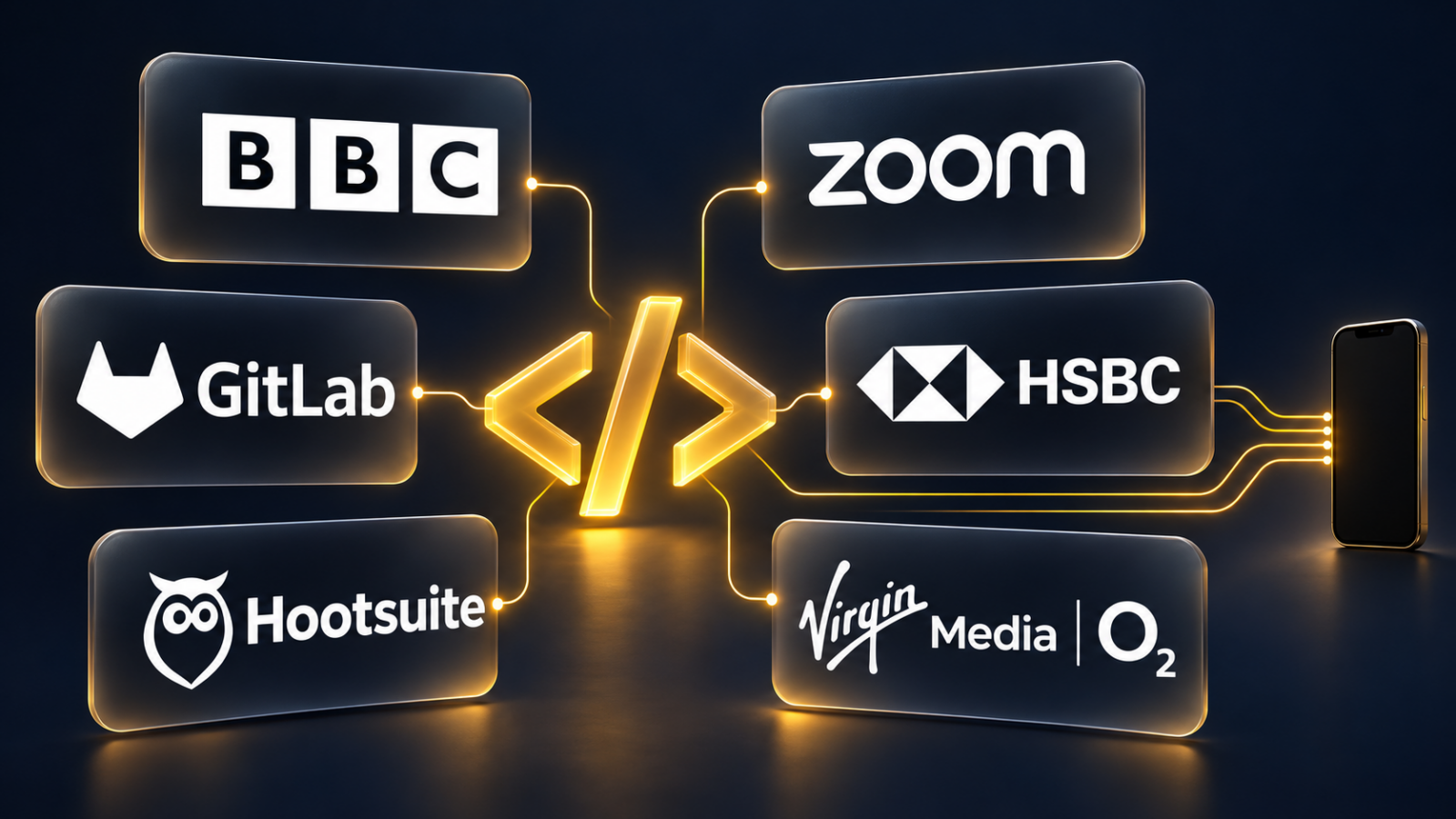
Poisoned third-party JavaScript on major websites connects two threats: browser-based financial theft and delivery of iPhone exploit-kit stages. Hudson Rock recovered malicious Optimizely project files and a minute-ly loader. Additional evidence supplied by Kirk from Ohey extends the affected delivery infrastructure to Kissmetrics and StorifyMe and links the mobile branch to Coruna and DarkSword. [14]
The scale of the websites matters: BBC.com alone reports an average monthly audience of 149 million outside the UK. That is audience context, not a count of affected visitors. The number of malicious page loads, successful thefts and compromised devices remains unknown. [5]
Four providers served poisoned code
The confirmed compromise is malicious code inside responses served from third-party providers’ own script and widget endpoints. The affected files are not simply innocent names appearing in a request’s initiator stack. Kirk’s expanded evidence records the response bytes, size and SHA-256 for 15 website captures, spanning 16 vendor responses. Hudson Rock independently matched those hashes to the supplied archive records and directly recovered nine poisoned vendor files. [14]
| Provider | Evidence in served files | Malicious delivery |
|---|---|---|
| Optimizely | Hudson Rock recovered eight poisoned project files. Kirk supplied seven customer captures with injected project code, including plain and Base64 forms. The GitLab and Zoom archive hashes match Hudson Rock’s files. | 1688360[.]cc/track.js; an earlier BBC response also loads webshell[.]lol/get.js. |
| Kissmetrics | Kirk verified the same 213-byte shared loader on three unrelated sites and a second poisoned customer script. The archive response hashes were independently corroborated. | webshell[.]lol/get.js |
| StorifyMe | Kirk verified malicious shared web-component responses and customer widget responses. The shared component hash appears on both the .com and .xyz CDN hosts. | webshell[.]lol/get.js with ?sm= or ?paid= markers. |
| minute-ly | Hudson Rock directly recovered the 561-byte malicious loader, matching Kirk’s Fox Sports archive hash. The copies with and without ?v=3 were identical. | webshell[.]lol/get.js |
In Optimizely’s case, the injection sits inside customer projectJS configurations, alongside legitimate experimentation code. Some versions use a plain loader, others encode the URL, and the BBC and HSBC UAE specimens embed a complete fallback payload. The code is not uniformly an identical line at the end of every customer file.
The shared responses and repeated injection establish a multi-customer delivery problem. They do not identify whether the original access involved provider infrastructure, publishing credentials, integrations or separate customer accounts. The evidence also does not establish a compromise of the named websites’ backend systems or every customer of these providers.
Hudson Rock also reviewed Amirul Cyber’s OptimJack research. Its asset leads helped expand the original sample set. Kirk’s later response-body evidence strengthens the findings for several sites that the first version of this report treated as researcher-reported leads. [1] [14]
Which websites are linked to poisoned responses?
The evidence below separates direct sample recovery from Kirk’s archived response-body verification. Both are more specific than a domain appearing somewhere in a dependency chain. Neither proves that every visitor loaded the malicious version or that a visitor lost data.
Hudson Rock’s original Optimizely sample set
| Web property | Poisoned asset path | Evidence |
|---|---|---|
| BBCbbc.com | /public/4621041136/s/bbcx_prod.js | Malicious asset recovered. Remote loader plus a complete embedded fallback. BBC page association is documented in the OptimJack report. [1] |
| Zoomwww.zoom.com | /js/6395285578973184.js | Malicious asset recovered. Direct payload loader in project code; homepage association documented in the OptimJack report. [1] |
| GitLab marketing websiteabout.gitlab.com | /js/5113954737848320.js | Malicious asset recovered. Archived page capture records the request chain to the attacker payload. [2] |
| HSBC UAE public websitewww.hsbc.ae | /js/20350660683.js | Malicious asset recovered. Embedded fallback plus independent browser-request evidence. [4] |
| Hootsuitewww.hootsuite.com | /js/4894383279964160.js | Malicious asset recovered. The reported page was /error/lost-owly. The same asset is also referenced by Talkwalker. [1] |
| Talkwalkerwww.talkwalker.com | /js/4894383279964160.js | Direct page dependency verified. Hudson Rock retrieved homepage HTML referencing the poisoned Hootsuite-associated asset. This is a second website, not a ninth distinct asset. |
| Virgin Media O2www.virginmediao2.co.uk | /js/22914960707.js | Malicious asset recovered. The independently reported page was /help/identity. [1] |
| Stamps.comwww.stamps.com | /js/23755770403.js | Malicious asset recovered. Direct loader in project code; homepage association documented in the OptimJack report. [1] |
| Tricentiswww.tricentis.com | /js/26508490611.js | Malicious asset recovered. Direct loader in project code; homepage association documented in the OptimJack report. [1] |
Hootsuite and Talkwalker share one poisoned project. Talkwalker’s homepage HTML directly referenced 4894383279964160.js. This makes nine linked web properties in the table, while the number of distinct recovered Optimizely assets remains eight.
Additional sites in Kirk’s response-body verification
Kirk’s 15-capture table overlaps our findings for BBC, Zoom and GitLab and adds the 12 properties below. Together, the two tables identify 21 named web properties with the stated evidence. This is a documented subset of the activity, not an incident-wide victim count. [14]
| Web property | Provider and served resource | Archive observation (UTC) |
|---|---|---|
| securitybank.com | Kissmetricsi.kissmetrics.com/i.js | 2026-11-13 05:42 View recorded capture |
| buzzstream.com | Kissmetricsi.kissmetrics.com/i.js | 2026-11-13 10:35 View recorded capture |
| chicagoitsupport.com | Kissmetricsi.kissmetrics.io/i.js, and scripts.kissmetrics.io/7541feb9b98160c21c87c2a9218d9456e3918643.2.js | 2026-11-13 19:31 View recorded capture |
| faz.net | StorifyMestorifyme.xyz/widgets/faz-5746000/widget/custom/8746 | 2026-11-13 20:31 View recorded capture |
| smh.com.au | StorifyMecdn.storifyme.com/static/web-components/storifyme-elements.min.js | 2026-11-14 01:33 View recorded capture |
| unibas.ch | StorifyMecdn.storifyme.xyz/static/web-components/storifyme-elements.min.js | 2026-11-14 03:27 View recorded capture |
| vidaxl.co.uk | StorifyMestories.storifyme.com/widgets/vidaxl/widget/custom/7094 | 2026-11-15 07:33 View recorded capture |
| salesforce.com | Optimizelycdn.optimizely.com/js/22444972181.js | 2026-11-16 14:32 View recorded capture |
| edition.cnn.com | Optimizelycdn.optimizely.com/public/125375509/s/landingprod.js | 2026-11-16 16:25 View recorded capture |
| foxsports.com | minute-lyapv-static.minute-ly.com/resources/v2/loader.js?v=3 | 2026-11-16 16:26 View recorded capture |
| mutualofomaha.com | Optimizelycdn.optimizely.com/js/25010540072.js | 2026-11-16 18:04 View recorded capture |
| foxnews.com | Optimizelycdn.optimizely.com/js/5728063363743744.js | 2026-11-16 18:25 View recorded capture |
CNN, Salesforce, Mutual of Omaha and Fox News now have specific historical Optimizely response evidence. In particular, the Fox News file is /js/5728063363743744.js. The result does not depend on interpreting a Confiant wrapper or Salesforce helper as the compromised vendor.
Kirk reports 51 traced sites in the wider investigation, but his supplied body verification covers the 15 captures above. Broader initiator-only leads are not silently promoted into this verified subset. The HSBC UAE asset recovered by Hudson Rock is also distinct from the HSBC Singapore insurance project mentioned in wider reporting.
Historical evidence remains relevant when a later response changes. Hudson Rock’s later copies of several reported assets lacked the known injection; those later copies do not invalidate the earlier archive hashes and body findings.
Large audiences, specific browser-level risks
The affected asset associations span news, banking, communications, software and business services. Their importance comes from the audiences that trust these websites and the actions a browser may perform after it loads the script.
| Organization | Published scale | What the figure means |
|---|---|---|
| BBC.com | 149 million average monthly audience outside the UK, as stated by BBC Studios in 2026. [5] | A website-audience measure. The incident window, affected paths and execution rate remain unknown. |
| GitLab | More than 50 million registered users, reported September 1, 2026. [6] | Platform-wide registrations. The captured page is on the marketing site, not evidence of exposure across GitLab accounts or repositories. |
| HSBC Group | Around 41 million customers worldwide, on an official page updated November 11, 2026. [7] | Global group scale. Our confirmed asset concerns the UAE public website, not all HSBC banking services or customers. |
| Virgin Media O2 | 46.3 million mobile connections at September 30, 2026, reported November 3. [8] | Connections include wholesale and IoT. They are not individual people, website visitors or affected accounts. |
| Hootsuite | More than 6,000 enterprise customers, on its official company page reviewed November 16, 2026. [9] | An undated company-reported customer count. It does not measure affected website sessions or connected social accounts. |
These figures must not be added together or presented as victims. Monthly audience, registered accounts, global banking customers, network connections and enterprise customers are different measures. None measures the number of people who encountered this payload.
| Visitor context | Potential impact supported by the code | Limit of the current evidence |
|---|---|---|
| News and sports visitors BBC, CNN, Fox News, Fox Sports, FAZ, Sydney Morning Herald | A large audience can encounter third-party code during an ordinary article visit. The track.js route can alter accessible content and conditionally collect readable cookies and a page image; the mobile delivery route introduces a separate exploit-stage risk. | No count of affected readers or successful collection has been established. A page visit alone does not prove card theft. |
| Public software and business-service pages Zoom, GitLab, Salesforce, Hootsuite, Talkwalker, Tricentis, BuzzStream | Accessible forms, values and page-visible session information become relevant if the poisoned script executes there. A legitimate business website can become the delivery point for attacker code. | The evidence does not establish access to meeting content, source repositories, social accounts, customer workspaces or internal product data. |
| Financial services, telecom, retail and shipping-service visitors HSBC UAE, Security Bank, Mutual of Omaha, Virgin Media O2, Stamps.com, vidaXL | Where track.js was delivered, its card module can inspect accessible complete card details and its swapper can alter cryptocurrency destinations. A response that only delivers webshell/get.js establishes the mobile-router path, not the presence of those financial-theft modules. | An affected public page is not proof that online banking, a checkout or an account portal also loaded the script. Each sensitive path must be checked separately. |
The wallet and card modules operate through a page’s accessible content and APIs, subject to same-origin and HttpOnly restrictions. Separately, a functioning browser or device exploit could extend access beyond that page. The iOS delivery evidence below raises that additional risk but does not demonstrate successful exploitation or establish which data a later stage obtained. [11] [12]
The mobile branch connects to Coruna and DarkSword infrastructure
The original recovered track.js already showed iOS-specific secondary loaders. Kirk’s additional work follows that branch further: into a router associated with Coruna and DarkSword delivery. Hudson Rock independently reviewed the two supplied scan records and their response hashes. [14] [19] [20]
1688360[.]cc/track.js implements wallet substitution and card skimming, and adds secondary loading for visitors identified as iOS.
webshell[.]lol/get.js loads the mobile router using the same channel marker.
02111110.icu boot routerA8 / Coruna-associated delivery; D11 / DarkSword-labelled delivery; C10 configured but unverified
What the two iOS-directed captures actually show
The 21:08:43 UTC GitLab scan presented an iOS 18.6 Safari user-agent string. Its records show successful responses for both boot.js hosts, 5vobauua3ojpklx[.]icu/D11/b.html, and eil786npto9u5bq[.]icu/JIUJIU888/index.js. Other requests, including D12/b.html and an ios-hack[.]icu IP-sync call, appear without a completed response. [19]
The 21:12:49 UTC scan presented an iOS 17.5 Safari user-agent string and received eil786npto9u5bq[.]icu/A8/a.html and A8/34ef644ff217a50beadde64dc8e23a7d.js. [20]
These are delivery observations, not demonstrated iPhone compromises. URLScan uses headless Google Chrome and allows a custom user-agent string. Changing that string does not create Safari’s WebKit engine or an iOS kernel. Successful HTTP responses therefore establish what the router served, not whether an exploit succeeded on an Apple device. [16]
| Version value in the reported router | Configured entry | What the evidence establishes |
|---|---|---|
| 13 through 17 | /A8/a.html (Coruna-associated) | A capture presenting an iOS 17.5 Safari user-agent string received the entry page and its packed JavaScript stage. This is delivery evidence, not a proven compatibility range. |
| 18 through 25 | /D11/b.html (DarkSword-labelled) | The iOS 18.6 user-agent capture received the D11 entry and Coruna-associated auxiliary JavaScript. The range is the router’s numeric branch, not a list of tested iOS releases. |
| 26 | /C10/b.html | Present in Kirk’s reported router logic. His iOS 26.3 user-agent test did not load track.js, leaving the branch untested. |
| Above 26 | No chain selected in the reported logic | A code branch is not an assurance that a device cannot be targeted through another version or route. |
Why the Coruna and DarkSword connection is credible
| Linking observation | Evidence and interpretation |
|---|---|
| Shared configuration | 02111110 appears in the track.js iOS loader and Kirk’s webshell/get.js specimen. Shared hosts and configuration connect the two delivery paths. |
| Coruna dispatcher | Kirk reports that both JIUJIU888/index.js and the A8 packed script install globalThis.obChTK from a Base64 module map and match his existing Coruna detection rule. This is the strongest code-structure link in the supplied downstream analysis. |
| DarkSword-labelled entry | Kirk identifies the D11 entry as a DarkSword delivery page. Its telemetry, /api/gs_state and /api/pe_ok gates precede a frame.html load. Downstream DarkSword stages were not fully inspected in his supplied account. |
| Related kit lineage | Kirk relates these entry paths, dispatcher patterns and visitor markers to the Caishen iOS C2 V2 ecosystem described in Ohey’s earlier research. This supports a kit/delivery relationship, not a proven operator identity. |
Kirk’s notes identify ds_ visitor keys stored as ds_vk, configuration object __DAILI_CFG, and a hidden 320 by 568 frame named chainFrame with data-daili-gate="v1". He reports XOR-encoded API and C2 host strings in the router, decoded with key d7K9mP2x. The entry code collects device and landing-page telemetry and uses IP-sync and execution-state endpoints. His D11 analysis also describes a once-per-24-hour frame gate and a 30-minute pause after two failures. These are researcher-supplied static findings, not timings measured on victim devices. [14]
The same channel and infrastructure support linked delivery activity across the November 13 and November 16 observations. They do not prove that one person controls all affected vendors, identify the kit’s buyer, or establish a shared initial-access mechanism. A commercial kit can be reused by multiple operators.
C10 does not establish a working iOS 26 exploit
In its November 5 report, updated November 6, Ohey documented a related router with C10 disabled and unavailable on the hosts checked. Earlier staged C10 files contained generated offsets and placeholder values. Ohey also found the combined kit advertised as Caishen iOS C2 V2. Those historical observations do not determine the current state of different campaign hosts. [15]
Kirk’s current notes contain a version-26 C10 branch, but the supplied iOS 26.3 test did not reach track.js. A configured route is not proof of deployed, functional exploit code, and the failed delivery test is not proof that the device version is safe.
There is also a browser-identification limit: Safari 26 freezes the operating-system token in its user-agent string to an older value. A router’s version labels cannot be equated with real-device behavior without inspecting its parser and validating the relevant environment. [17] [18]
The supported conclusion is a connection to exploit-kit delivery infrastructure. The current evidence does not establish a zero-day, successful device exploitation, or collection of specific device data by unseen downstream stages.
Blocking the attacker domain can leave the malware running
The BBC and HSBC UAE scripts contain more than a reference to an external file. Each embeds the same 24,392-byte malicious payload in Base64, already present inside the Optimizely response.
The loader decodes that payload locally, then attempts to fetch remote track.js. If the request errors, or has not completed after 2.5 seconds, it attempts to execute the embedded copy. A later check can retry retrieval through fetch and XMLHttpRequest when the expected execution marker is absent.
Remote URL plus a complete embedded payload
Address replacement, collection logic and iOS-specific loading are present in the recovered live variant.
A complete malicious copy is already in the trusted CDN response. Local address substitution does not require a fresh download from the attacker host.
A DNS or network block is useful, but it does not remove the poisoned trusted script. It may stop requests to the blocked host while leaving local wallet-address substitution available from the embedded code. The separate iOS hosts are additional destinations. A site’s CSP may constrain execution paths, but containment should verify removal of the injected project code and the bytes delivered to visitors.
The live and embedded payloads are different variants. The live sample has additional request and function hooks, raw-format TON handling and a second iOS loading path. Their card-skimming module is byte-identical. The comparison establishes different capabilities, not a proven development chronology.
Wallet substitution and card skimming accompany the mobile branch
The behavior below comes from Hudson Rock’s recovered live payload and decoded fallback. Their wallet and card modules are not restricted to desktop visitors; iOS detection adds secondary loading rather than replacing those modules.
1. Cryptocurrency address replacement
The script contains hardcoded replacement destinations for Ethereum/EVM-style addresses, Bitcoin, TRON, TON, Solana, Litecoin, Bitcoin Cash and Dogecoin. It recognizes address formats and validates checksums for several families before substituting the destination. EVM recognition is format-based, while Solana matching includes heuristics.
Its targets include visible text, input and textarea values, selected element attributes, links, copy events and clipboard API calls. The live variant also attempts to modify address-bearing strings in some request bodies, request URLs, navigation/history operations and sharing calls. Mutation observation and a 50 ms scan interval while the page is visible help it revisit content that changes after load.
The effect can be a payment sent to a destination the attacker placed into the page or copied value. The code does not need to obtain a private key to attempt this diversion. In the recovered samples, we did not identify seed extraction, wallet-signing calls or a mechanism proving an automatic on-chain transfer.
Address replacement is not uniformly restricted to payment-related keywords. In the core text-replacement function, context affects whether an original address is recorded for collection; valid matches can still be replaced without that logging condition. URL processing has its own additional checks.
2. Payment-card skimming
The card module hooks form submissions and POST bodies sent through fetch and XMLHttpRequest. It can inspect JSON-like bodies, URL-encoded parameters and FormData for a card number, expiry and security code.
Before attempting transmission, it requires a recognized card-number prefix, a Luhn-valid number, an expiry matching its checks and a three- or four-digit CVV/CVC. It then attempts to send the complete tuple to 1688360[.]cc/card.php, using sendBeacon when available.
card.php fields
n = card number
e = expiry
c = CVV / CVC
u = page URL
This is implemented card-skimming behavior, not evidence that every affected page presented a payment form or that a card was actually transmitted. The code does not demonstrate bypass of cross-origin hosted-payment-frame isolation. [12]
3. Conditional cookie and page-image collection
A separate routine prepares a POST to 1688360[.]cc/hit.php containing the page URL, JavaScript-readable cookies, recorded address matches and an optional JPEG rendering of the viewport. It uses html2canvas, requesting the helper from the attacker host if a usable instance is not already present.
This path is conditional, not a beacon that runs for every visitor. The screenshot routine requires recorded address matches, follows relevant visible changes and is guarded to run once per page. If rendering fails, the routine can attempt to send its other fields without an image.
The constructed fields include up to 500 characters of URL and 8,000 characters from document.cookie. A readable session cookie could therefore be included, but HttpOnly cookie values remain unavailable to this JavaScript API. We did not identify a localStorage extraction routine. [11]
The image is a rendering of page content. It is not an operating-system screenshot and does not by itself show access to unrelated tabs or applications.
4. iOS-specific loading in the recovered variant
The live sample recognizes iPhone, iPad and iPod user agents and an iPad-style Macintosh/touch combination. It inserts two boot.js references with the 02111110 channel marker. A separate branch adds JIUJIU888/weifile.html when the parsed major/minor iOS version is 18.6 or below; patch versions are not distinguished by that check.
Hudson Rock’s initial direct requests received small Site Unavailable pages. Kirk’s later supplied captures show that other request conditions obtained router and entry-stage responses. An unavailable response in one retrieval is therefore not evidence that the downstream delivery was universally inactive.
No mining implementation was identified in the recovered variants. The SHA-256 code is used for cryptocurrency-address checksum validation. Its presence does not establish cryptocurrency mining.
The evidence spans multiple dates and payload versions
| Observation time (UTC) | Evidence |
|---|---|
| November 13, 05:42 | Kirk’s Security Bank capture records a poisoned Kissmetrics response and webshell/get.js. This is the earliest vendor-response observation in the supplied verified subset. |
| November 13, 20:31 | A FAZ capture records a poisoned StorifyMe widget response. Later captures include Sydney Morning Herald, University of Basel and vidaXL. |
| November 16, 04:31 | The BBC Optimizely response in Kirk’s archive loads webshell/get.js. Its hash differs from Hudson Rock’s later BBC specimen. |
| November 16, 11:41 | The Zoom capture records the same poisoned Optimizely asset hash later recovered by Hudson Rock. |
| November 16, 16:07 and 16:17 | Earlier track.js hashes appear in the supplied captures. The 16:17 GitLab marketing-page scan records the Optimizely-to-track.js delivery. [13] [2] |
| November 16, 17:16 to 17:29 | The independent HSBC UAE archive records the project file and a track.js request/reference. [4] |
| November 16, 19:03 and 20:51 | urlscan and Cloudflare Radar record the track.js hash matching Hudson Rock’s 29,882-byte sample. [3] [10] |
| November 16, 21:00 to 21:02 | Hudson Rock retrieves the main payload and poisoned GitLab, BBC and HSBC UAE assets. The BBC response contains the embedded fallback. |
| November 16, 21:08:43 | Kirk’s iOS 18.6 user-agent scan records the boot routers, D11 entry and auxiliary JIUJIU888 stage. [19] |
| November 16, approximately 21:10 | Kirk reports the GitLab, Zoom and minute-ly loaders still present, but a BBC response without the injection. This is his specific observation, not a global remediation time. |
| November 16, 21:12:49 | Kirk’s iOS 17.5 user-agent scan records the A8 entry and packed JavaScript stage. [20] |
| November 16, 21:13 to 21:14 | Hudson Rock retrieves five more poisoned Optimizely assets and verifies Talkwalker’s dependency on the Hootsuite-associated file. |
| November 16, 21:29 | Hudson Rock directly retrieves the poisoned minute-ly loader, matching the 561-byte Fox Sports archive specimen. |
The BBC observations illustrate why response versions and timestamps matter. A malicious file received at 21:00 and a different response received by another researcher at 21:10 can reflect an intervening change or different cache responses. Neither observation establishes the state of every edge cache, page or already-open browser session.
The early GitLab scan records delivery without a card.php or hit.php request. The later iOS-directed scans provide additional routing evidence. Delivery, completed response, exploit execution and data theft are separate findings and must not be treated as interchangeable.
Domains, paths, wallets, hashes and detection pivots
Evidence status is part of each indicator. An endpoint in code, an attempted request, a successful response and verified data collection are different observations. Related historical Ohey infrastructure is not automatically promoted into the current campaign’s blocklist.
Network destinations
| Indicator | Role | Evidence status |
|---|---|---|
1688360[.]cc/track.js | Financial-theft payload and iOS-loading references. | Live bytes recovered; matching archive hashes. |
1688360[.]cc/card.php | Card-number, expiry, CVV/CVC and page-URL collection endpoint. | Referenced in recovered code; no successful victim submission demonstrated. |
1688360[.]cc/hit.php | Conditional URL, readable-cookie, address-match and page-image collection. | Referenced in recovered code; collection is conditional. |
1688360[.]cc/html2canvas.min.js | Page-rendering helper used by the collection routine. | Supporting bytes recovered. The library name alone is not malicious. |
1688360[.]cc/px.gif | Error-telemetry path in the embedded-payload loader. | Referenced in recovered code. |
webshell[.]lol/get.js | Small loader for the mobile router, with channel 02111110; observed with ?sm= and ?paid= markers. | Archive hash corroborated across providers; body analysis supplied by Kirk. Current direct request returned HTTP 403. |
5vobauua3ojpklx[.]icu/boot.js | Mobile router. | HTTP 200 response and hash recorded in both iOS-directed scans. |
5vobauua3ojpklx[.]icu/D11/b.html | DarkSword-labelled entry. | HTTP 200 recorded in the 18.6 user-agent capture; code analysis supplied by Kirk. |
5vobauua3ojpklx[.]icu/api/track; /api/gs_state; /api/pe_ok | Telemetry and execution-state gates. | Request records and Kirk’s analysis. A request to pe_ok is not proof of successful privilege escalation. |
eil786npto9u5bq[.]icu/boot.js | Second boot script with its own distinct sample hash. | HTTP 200 recorded; do not merge its hash with the first boot host. |
eil786npto9u5bq[.]icu/A8/a.html | Coruna-associated entry. | HTTP 200 recorded in the 17.5 user-agent capture. |
eil786npto9u5bq[.]icu/A8/34ef644ff217a50beadde64dc8e23a7d.js | Packed Coruna-associated dispatcher stage. | HTTP 200 and hash recorded; structural identification supplied by Kirk. |
eil786npto9u5bq[.]icu/JIUJIU888/weifile.html; /JIUJIU888/index.js | Auxiliary frame and packed Coruna-associated stage. | Successful responses recorded; structural identification supplied by Kirk. |
eil786npto9u5bq[.]icu/D12/b.html | Additional entry request in the 18.6 user-agent trace. | Incomplete/failed response record; successful delivery not established. |
eil786npto9u5bq[.]icu/api/track; /chain_log | Entry telemetry and result logging. | Referenced in Kirk’s supplied trace and analysis; result labels do not independently prove exploit success. |
je4ft3gn8vxudum[.]icu | c2Base decoded from boot.js. | Kirk’s code-level finding; a completed communication to this host is not established here. |
ios-hack[.]icu/api/ip-sync/sync | IP synchronization request with visitor identifier. | Request attempt recorded; no completed response in the examined trace. |
l7bcsnwc7nzr3uo[.]icu/api/iptj | Additional telemetry endpoint in the supplied iOS trace. | Recorded request corroborates a domain previously treated as reported-only. |
136.113.106[.]136 | Historical IP for 1688360[.]cc; AS396982, Google Cloud. | Recorded scan infrastructure; not operator attribution or a blanket shared-hosting indicator. [10] |
ipv6.icanhazip.com appears in Kirk’s description as a public IP-discovery service. Its use by the router does not make that legitimate service attacker-owned or a reliable standalone indicator.
Hardcoded cryptocurrency destinations
| Address family | Hardcoded replacement destination |
|---|---|
| EVM-style | 0xC4026b06D82b0F0B363eda0642D61CfbDc17884e |
| TRON | THvs6p56XkUiMkJeSc51cAP64u2RsTYqxa |
| Bitcoin | 19g9rZcPeiz8rUvyWpTRyXXhPnjsWrc3kW |
| TON user-friendly | UQAgM1VqSZQiJLSG5w-ovurq5CZdxLEK3_7CMmwALTA5e09p |
| Solana | FVtL8NMYS9PA1v3HE67XUGCtGA9JaZUvqav2fU2LrV5n |
| Litecoin | ltc1q3wp7g6ds0ggg6fl6kncpa4sepn0q3qfacgred5 |
| Bitcoin Cash | qzkaaf8n6grmpr0d9lx8xutn3r9lk722f566hhpe58 |
| Dogecoin | DBEGrxRF7KMSuhTS4c1MFviStU6efdMnu5 |
| TON raw | 0:2033556a49942224b486e70fa8beeaeae4265dc4b10adffec2326c002d30397b |
Hashes of directly recovered malicious specimens
| Specimen | SHA-256 |
|---|---|
| Live track.js 29,882 bytes; recovered | f7b84b9a94f749f8ced3f0112d0a66894e8bbc3b4aa5592021d1b8976a9bad40 |
| Embedded payload 24,392 bytes; decoded from BBC and HSBC UAE | c2a34c579e4c2e8802752c93b3a9cca0230610f3e4dd6688f4272459c7c7c162 |
| GitLab marketing site asset | a87a2eaea9cfb74aae7283d15fbdb499b5a8ebc3fab4c453df7d62e503996240 |
| BBC asset | 305d0b00a7bafae9f240dbaf5bfdbb19648e38e509e8992112fcb7866c2e37dc |
| HSBC UAE asset | 295f2ff6b934e7be8c07d501b0561a9a7da29e0fa775b742613a6edb0d0b6069 |
| Hootsuite / Talkwalker asset | 3fa37e49fbf39434d03a6078d2d6cffcd4451fa0d4eccdea8c48b7462c780dd4 |
| Stamps.com asset | aa0706634eecc9d833c8a0b353099c26083f22bd742ccf81d8942ed6b1798b75 |
| Tricentis asset | d3f01f57103b8bcf07b6f18551f29885ffd61de190e2184249f824d2c268e09f |
| Virgin Media O2 asset | 19b1f83f333424326aaceaa4e84dac2a378684b4d2475c73b272b2e4b409e415 |
| Zoom asset | 9cab90c80b9a668cbf3ba2489671e7870885273ceb7c0e56ae478fceb14ffc34 |
| Specimen | SHA-256 |
|---|---|
| minute-ly loader 561 bytes; directly recovered by Hudson Rock; matches Fox Sports archive | 0f2f2a27d19112e5800541daecc91eb6c77e49f9b43ed23c890b876631978533 |
Mobile-router and stage hashes from archive records
| Recorded resource | SHA-256 |
|---|---|
webshell[.]lol/get.js | 123f813b18cf5a3b513beabd52a110e19f1c7834f2aa9b972633b2214c57e737 |
5vobauua3ojpklx[.]icu/boot.js | 8d69f32fff37208e52dc573111e8db99f031f4913845a24fb2e14755747ac860 |
eil786npto9u5bq[.]icu/boot.js | e410b6509f33defce16ad7896cbe2fb3cc689f2cc53d87c87d75efba6b57e290 |
eil786npto9u5bq[.]icu/JIUJIU888/weifile.html | f286c965982bee4225c4edda261ce8685a55721dd997ddedf106666101118c07 |
eil786npto9u5bq[.]icu/JIUJIU888/index.js | 435987c1d7f4da3d4a6d3175538d32751d1a6d55a38dcc9d39c24399a8eaa6fa |
5vobauua3ojpklx[.]icu/D11/b.html | 792deb03483ce9b212df6f46319a78ea6fc39bfc5b2719c7e8b87d084524437d |
eil786npto9u5bq[.]icu/A8/a.html | 9039ebbdd6abe36ad8ac48097dae6813d4a49315e1403c9ae7ebab539601cde6 |
eil786npto9u5bq[.]icu/A8/34ef644ff217a50beadde64dc8e23a7d.js | 7175872c4fff6eba2bb98f5a86093f80178baac85b0973a344a4720aab806b92 |
Kirk reports 12,088 bytes for the first boot script and 12,637 for the second. The two hashes above are bound to their exact URLs in the scan records. They are distinct from the separately reported boot sample in the historical-hash table below. [14] [19] [20]
Archived vendor responses: all 15 site captures, resources and hashes
| Capture | Served resource and size | Recorded SHA-256 |
|---|---|---|
| securitybank.com 2026-11-13 05:42 UTC 01a1d36d-6159-74f2-84cf-7b1c30d6445d | i.kissmetrics.com/i.js213 bytes, as supplied by Kirk | c154f3b644cd51f2446483c7ffd2ae4f178c4b0cb54846cfb5b83215367349cf |
| buzzstream.com 2026-11-13 10:35 UTC 01a1d479-8594-75c9-ab69-e63384e9133b | i.kissmetrics.com/i.js213 bytes, as supplied by Kirk | c154f3b644cd51f2446483c7ffd2ae4f178c4b0cb54846cfb5b83215367349cf |
| chicagoitsupport.com 2026-11-13 19:31 UTC 01a1d664-66c2-75fb-a91f-f93d456495d3 | i.kissmetrics.io/i.js, and scripts.kissmetrics.io/7541feb9b98160c21c87c2a9218d9456e3918643.2.js213; 26,456 bytes, as supplied by Kirk | c154f3b644cd51f2446483c7ffd2ae4f178c4b0cb54846cfb5b83215367349cf; aebab839a4335477a51d75ce19d0596df5bed4259c2444aba664f2602ce24618 |
| faz.net 2026-11-13 20:31 UTC 01a1d69b-8e22-73c9-a31e-9c1b0d86840b | storifyme.xyz/widgets/faz-5746000/widget/custom/874616,569 bytes, as supplied by Kirk | 94d174abe1e3b12b000f2bc8cbd8e9344290f4b5a8661c8d700cdc5675675fba |
| smh.com.au 2026-11-14 01:33 UTC 01a1d7b0-00f6-748b-9fcf-bbea9764e93c | cdn.storifyme.com/static/web-components/storifyme-elements.min.js793 bytes, as supplied by Kirk | 0408c5e199664c7841c4dfdb6e5065ca394f11247e5ed992ce28ecaafc936455 |
| unibas.ch 2026-11-14 03:27 UTC 01a1d818-b73d-71cc-956d-29ebe10eb3ff | cdn.storifyme.xyz/static/web-components/storifyme-elements.min.js793 bytes, as supplied by Kirk | 0408c5e199664c7841c4dfdb6e5065ca394f11247e5ed992ce28ecaafc936455 |
| vidaxl.co.uk 2026-11-15 07:33 UTC 01a1de20-1103-72e9-bd00-961a846d1337 | stories.storifyme.com/widgets/vidaxl/widget/custom/709412,571 bytes, as supplied by Kirk | 0d13b2c39d5911cc6a17eeeda72d40f86fce6cb0665faef22df204f6ee0a60b7 |
| bbc.com 2026-11-16 04:31 UTC 01a1e2a0-0751-759b-9108-5a7513d24344 | cdn.optimizely.com/public/4621041136/s/bbcx_prod.js432,309 bytes, as supplied by Kirk | 45e42f5fa7520f6e7c048587f025549b31f0f24be8be058c7037d1da37e37b67 |
| zoom.com 2026-11-16 11:41 UTC 01a1e429-5fc2-754a-92bd-71f68d9bbac7 | cdn.optimizely.com/js/6395285578973184.js312,421 bytes, as supplied by Kirk | 9cab90c80b9a668cbf3ba2489671e7870885273ceb7c0e56ae478fceb14ffc34 |
| salesforce.com 2026-11-16 14:32 UTC 01a1e4c5-b930-7228-96a0-e7c3bf60b0b7 | cdn.optimizely.com/js/22444972181.js492,416 bytes, as supplied by Kirk | 515ddf846086fec3215c2574611b4c338f5b7533a8fd5f3c2234c35bf7f7c004 |
| edition.cnn.com 2026-11-16 16:25 UTC 01a1e52d-28a4-75b1-b154-b8764ff0c384 | cdn.optimizely.com/public/125375509/s/landingprod.js528,868 bytes, as supplied by Kirk | b18941eb7623508594483dc4b338a02661730a363b6732806c539640f981ee44 |
| foxsports.com 2026-11-16 16:26 UTC 01a1e52d-c503-761c-9d06-d9913d921994 | apv-static.minute-ly.com/resources/v2/loader.js?v=3561 bytes, as supplied by Kirk | 0f2f2a27d19112e5800541daecc91eb6c77e49f9b43ed23c890b876631978533 |
| mutualofomaha.com 2026-11-16 18:04 UTC 01a1e588-4ab4-7794-a776-a0172e53a895 | cdn.optimizely.com/js/25010540072.js632,365 bytes, as supplied by Kirk | 5913a8225d16b7d3caf0bef504307c8c89e958fd27cd2be59f45108fd09991aa |
| foxnews.com 2026-11-16 18:25 UTC 01a1e59a-8977-77fb-bf78-ced17e25210e | cdn.optimizely.com/js/5728063363743744.js353,774 bytes, as supplied by Kirk | 8bf4cb2fd2d31ccf209bfa58e21e488e61bc2ab9fa3e1ed11b98f4e0618fab98 |
| about.gitlab.com 2026-11-16 16:17 UTC 01a1e526-61a1-74f5-bc12-c7ec2762ef99 | cdn.optimizely.com/js/5113954737848320.js354,471 bytes, as supplied by Kirk | a87a2eaea9cfb74aae7283d15fbdb499b5a8ebc3fab4c453df7d62e503996240 |
Earlier and externally reported payload builds
| Recorded sample | SHA-256 |
|---|---|
| track.js in the 16:07 UTC scan Archived metadata only; body not recovered [13] | 617df364120adc47fb4f55dcc0c69a9b6c9e108a92c60bc2b64a266254ab02f3 |
| track.js in the 16:17 UTC scan Archived hash; earlier build analyzed by Kirk; body not recovered by Hudson Rock | 450794992ffe035dce462ef669c6ac46e1a9e87b7b0af3e8f9040f9436cd896f |
| eil786…/boot.js Reported by Amirul Cyber; matching bytes not recovered by Hudson Rock | 2f69879f1c5bdfe9c075ef67ddb6405afe992aff89dcf42863567f83237d3ba6 [1] |
Additional reported-only domains
These four domains remain alerts supplied through the original researcher posts, without a matching request or body in the records examined here. l7bcsnwc7nzr3uo[.]icu has moved into the recorded-request table above.
q1ls1ho9x7wsxlu[.]icu
p55abnw2pnsz0bo[.]icu
1y69gy2mdzaltz1[.]icu
gm38duxoihbmy5o[.]icu
Code, storage and routing markers
Financial-theft payload
window._k7   window._cc   window._shot   window._qxc
sessionStorage key prefix: cc_

Mobile routing and stages
channelCode / data-channel-code: 02111110
visitor-key prefix: ds_
visitor storage key: ds_vk
configuration object: __DAILI_CFG
frame id: chainFrame
frame attribute: data-daili-gate="v1"
dispatcher: globalThis.obChTK
Base64 module-map marker: let MM=
entry paths: /A8/a.html, /D11/b.html, /D12/b.html, /C10/b.html
auxiliary path: /JIUJIU888/weifile.html
Use these strings in combination with origin, path, content and timing. They are not individually reliable signatures. The card-deduplication keys can contain card details and require appropriate evidence handling. The C10 marker is a hunting lead, not proof that its route delivered a working exploit.
Remove the delivery code and investigate both forms of exposure
- Preserve and remove the affected third-party code. Retain actual response bytes, hashes, headers, timestamps and project revisions before restoring or disabling the relevant project or resource. Inspect Optimizely
projectJS, the affected Kissmetrics/StorifyMe endpoints and minute-ly’s loader where used. Verify what visitors actually receive after changes. - Block both delivery paths and the observed downstream hosts. Cover
1688360[.]cc,webshell[.]loland the current mobile-router indicators. Domain blocks are only one layer: the BBC and HSBC UAE specimens already contain a complete embedded payload. - Preserve responses and network traces, not just the final page DOM. The minute-ly specimen schedules removal of its own and related script elements after three seconds. Removing elements does not undo executed code, but it can make a later DOM-only inspection incomplete.
- Separate financial-theft exposure from mobile-stage delivery. Hunt for
card.phpandhit.phpPOST attempts, boot/entry-stage requests and state/telemetry calls as separate events. An endpoint namedpe_okor a result parameter is not independent proof that privilege escalation occurred. - Scope sensitive pages and device exposure individually. Determine whether payment, login, account or other sensitive paths loaded the affected file during the relevant period. Check applicable browser/device versions and seek device-level forensic evidence if exploit exposure is suspected. Refresh affected software and follow verified vendor guidance. Invalidate exposed sessions or coordinate payment-data response where the evidence supports it.
- Investigate the publishing path. Review project changes, publication history, account activity, API credentials and integrations with the relevant providers. Shared malicious output establishes the integrity problem; it does not by itself reveal how the attacker gained access.
For visitors, the relevant questions are which page was loaded, when, on which device, and what was entered or copied. Cryptocurrency payment destinations should be checked through an independent trusted view. An organization-specific exposure notice should guide any payment or session response; membership in a large customer population alone does not establish compromise.
The new evidence changes the scope of the investigation. This activity combines ordinary browser theft with delivery infrastructure associated with iPhone exploit kits. Containment must address the poisoned trusted scripts and both downstream delivery paths, while incident reporting keeps requested stages, executed code and confirmed losses distinct.
What the combined evidence establishes
Hudson Rock retrieved JavaScript and supporting HTML as data, preserved bytes and SHA-256 hashes, decoded the embedded Base64 payload without evaluating it, compared variants and reviewed existing scan records. No malicious code was executed in Hudson Rock’s analysis, no new scan was submitted, and no collection endpoint was supplied victim data.
The expanded source is Kirk’s updated November 16 research note, supplied directly to Hudson Rock. It records 15 website captures containing 16 poisoned vendor responses. Hudson Rock independently corroborated all 16 recorded hashes and vendor URLs, and directly recovered the minute-ly loader in addition to the original eight Optimizely assets. For historical bodies unavailable in our retrieval, their code interpretation remains explicitly attributed to Kirk.
The two iOS-directed scan records also corroborate response hashes and route selection. URLScan’s Chrome engine makes these delivery tests, not real-device exploit validations. Kirk had not fully read the later DarkSword stages or decoded the Coruna module maps in the supplied account. The initial compromise mechanism, operator identity, visitor count and successful theft or device-compromise totals remain unresolved.
The GitHub issue referenced in the supplied notes was unavailable during this review and was not treated as independently reviewed public evidence. Audience metrics describe the organizations’ scale and cannot be added together or converted into incident counts.
- Amirul Cyber: OptimJack research and reported page-to-script associations
- urlscan: GitLab marketing-site capture, November 16, 2026, 16:17 UTC
- urlscan: archived track.js response record, November 16, 2026, 19:03 UTC
- Who Gets My Data: HSBC UAE browser-request evidence
- BBC Studios: BBC.com audience scale in its 2026 Africa Enterprise announcement
- GitLab: Q2 FY2027 results, published September 1, 2026
- HSBC: company history and global customer count, updated November 11, 2026
- Virgin Media O2: Q3 2026 operating metrics
- Hootsuite: official company page, reviewed November 16, 2026
- Cloudflare Radar: independent response hash and infrastructure record
- MDN: document.cookie and HttpOnly limitations
- MDN: same-origin policy and cross-origin frame access
- urlscan: earlier track.js response record, November 16, 2026, 16:07 UTC
- Kirk / Ohey: updated research notes supplied to Hudson Rock, November 16, 2026. Includes 15 archived response-body checks and iOS-directed scan findings. Source document SHA-256: 3c693a9e3117d84ba62a20012ba7d5c41f91ece27a5ec1b367e34bf7559fabdb
- Ohey: DarkSword router’s iOS 26 route, C10, is switched off; published November 5, updated November 6, 2026
- urlscan documentation: headless Chrome, custom user-agent support and point-in-time scan limitations
- WebKit: Safari 26.0 user-agent changes
- WebKit issue 298673: frozen OS token updated to 18.7
- Kirk-supplied GitLab capture using an iOS 18.6 Safari user-agent string, November 16, 21:08:43 UTC
- Kirk-supplied GitLab capture using an iOS 17.5 Safari user-agent string, November 16, 21:12:49 UTC